
Port pickup, warehousing, fulfillment and delivery from one asset-based team in Los Angeles. Get a quote for fulfillment that scales with your sales.
Pick and Pack Fulfillment: Process, Methods & Best Practices
Key Takeaways
- Pick and pack fulfillment is the warehouse work of pulling the items on each order from inventory, verifying them and packing them for the carrier, in four steps from order release to carrier handoff.
- Shipping speed depends on two clocks: how fast imported inventory becomes pickable, and how fast an order leaves the building once it drops into the warehouse system.
- Accuracy comes from slotting, barcode scans at picking and packing, and picking methods matched to order volume, not from asking people to work faster.
Pick and pack fulfillment is the process of picking the items on a customer order from warehouse inventory and packing them for shipment. It is where most fulfillment errors and delays are either made or prevented.
Most guides start the clock when the order arrives. For brands importing through Los Angeles and Long Beach, two clocks matter: how fast a container becomes stock a picker can reach, and how fast an order leaves the building once it drops into the warehouse system. This guide covers both, plus the process, the main picking methods and the practices that prevent mispicks.
How the Pick and Pack Process Works in a Warehouse
The pick and pack process, often called pick, pack and ship, follows the same four steps in almost every warehouse. What differs is how much of the work a warehouse management system (WMS) directs and verifies.
Order release from your store to the WMS
When a shopper checks out on Shopify, WooCommerce or a marketplace, the order flows through an integration into the WMS. The system confirms stock, assigns the order to a batch or wave, and generates a pick list with bin locations and quantities. Orders that need manual entry or wait for a scheduled import lose hours before anyone touches them.
Picking and scan verification
A picker follows the list, usually on a handheld scanner, to each bin location. Scanning the location and the item barcode confirms the right SKU and quantity at the shelf, which catches most mispicks before they reach packing. Look-alike items, such as the same shoe in two sizes, are where unscanned picking fails most often.
Packing, inserts and right-sized boxes
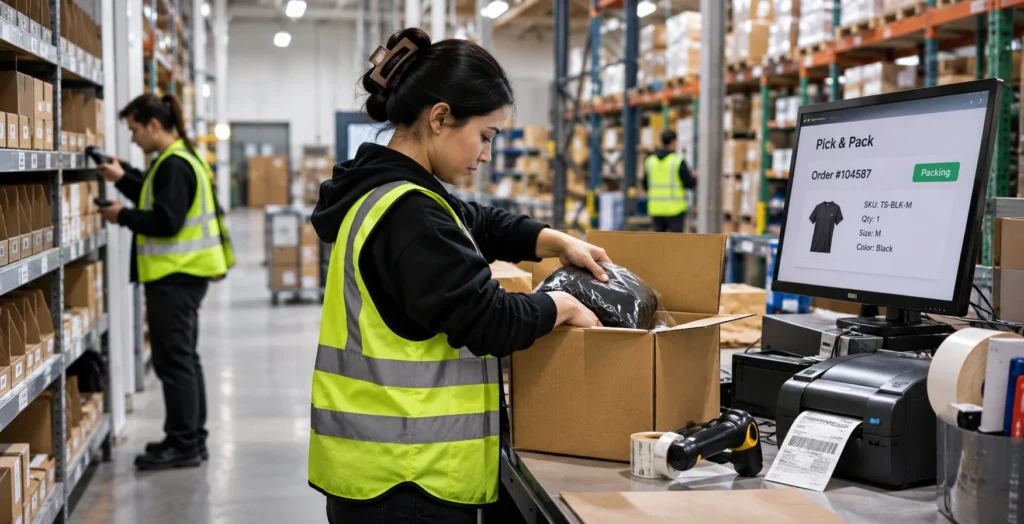
At the packing station, the packer scans each item again against the order, chooses a box or mailer that fits, adds protective fill and adds any inserts, gift notes or branded packaging the brand requires. This second scan is the last chance to catch an error before it becomes a return, and right-sizing matters because carriers bill by dimensional weight.
Labeling, staging and carrier handoff
The system weighs the package, rates the shipment and prints the label. Packed orders are staged by carrier and handed off at the scheduled pickup, and the tracking number flows back to the store. A package that misses the day’s last pickup ships a day late, however fast it was packed.
Picking Methods: Piece, Batch, Zone and Wave Picking
Warehouses choose a picking method based on order volume, SKU count and building size, and most run more than one.
Piece picking
Also called discrete picking, piece picking sends one picker after one order at a time. It is simple and accurate, but walking time grows fast with volume, so it suits low order counts or bulky items.
Batch picking
In batch picking, one picker collects the items for several orders in a single trip, then sorts them into orders. It cuts walking time when many orders share the same SKUs, common for DTC brands with a few bestsellers.
Zone picking
Zone picking splits the building into zones, and each picker works only in their own zone. Orders pass between zones or are consolidated at the end, which suits large facilities with high SKU counts.
Wave picking
Wave picking releases orders in scheduled waves, usually built around carrier pickup times or shipping priority, and each wave can be picked by batch, zone or piece. Several guides describe it simply as batch plus zone picking, but what defines it is timing. Shopify’s guide to pick and pack fulfillment has a good example of waves organized by shipping priority.
Pick and Pack Starts at the Port for Imported Goods
For an importer, the fastest picking floor cannot ship what is still sitting in a container. Inventory has to clear the terminal, reach the warehouse and be unloaded, counted and put away before a single order can be picked. Every delay upstream shows up as backorders, split shipments or listings that go out of stock while product sits a few miles away.
That is why the gap between the port and the pick face matters as much as pick rates. QX Logistix pulls containers with its own fleet of 65+ trucks and brings them to warehouses in Vernon and Commerce, 18 to 22 miles from the Ports of Los Angeles and Long Beach. The same team unloads, receives and racks the freight, so there is no handoff between a drayage carrier and a separate fulfillment warehouse.
Fewer handoffs also protect high-value inventory. Every transfer between carriers, yards and buildings is an opening for thieves, a risk we cover in our guide to cargo theft in California. QX’s buildings are fenced and monitored by 24/7 security cameras, and the company is CTPAT compliant.
What Decides How Fast Orders Ship Once They Drop In
Brands usually ask a fulfillment partner first how quickly orders ship once they land in the system. The answer depends on a few operational choices more than on how hard pickers work.
Order cutoff times
A cutoff is the latest time an order can arrive and still ship the same day. Cutoffs work backward from each carrier’s pickup time, minus the time needed to pick, pack and stage, so a partner should be able to give you its cutoffs by carrier.
Integrations and visibility
Orders that reach the WMS through a direct integration can be released for picking within minutes. QX runs on the Extensiv warehouse management system, with integrations for Shopify, WooCommerce and SAP, and barcode scanning at each step gives brands visibility into where every order stands.
Labor and operating hours
Promotions and viral products hit the picking floor first. A warehouse that runs extended hours seven days a week, as QX’s facilities do, can clear a weekend surge instead of starting Monday behind. One QX facility alone handles about 18,000 cartons a day.
DTC and B2B Pick and Pack From the Same Inventory
Many brands sell direct to consumers and wholesale to retailers from the same stock, but the picking work differs. DTC orders are each picks of a few units, packed in a mailer or small box and shipped by parcel. Retail replenishment orders are usually case or pallet picks, built to each retailer’s label and pallet requirements and shipped as freight.
One inventory avoids splitting stock between two warehouses, as long as the system allocates units by channel and the team knows each retailer’s rules. Costco, Home Depot, Sam’s Club and Amazon each have their own requirements for how pallets are built, which is why QX runs B2B and retail fulfillment alongside ecommerce orders in the same buildings.
Pick and Pack Best Practices That Prevent Mispicks
Accuracy comes from how the operation is set up, not from asking people to be more careful.
- Slot by velocity: keep the fastest-moving SKUs closest to packing and at waist height, and move slow sellers to upper or more distant locations.
- Separate look-alikes: store similar SKUs, such as one style in several sizes or colors, apart from each other so a picker cannot grab the wrong one from the next bin. This is a daily issue for apparel and footwear brands.
- Scan twice: scan at the pick location and again at the packing station. A mispick caught at packing costs seconds, while one caught by the customer costs a return, a reship and sometimes the customer.
- Pre-kit frequent bundles: if the same items often ship together, assembling them ahead of demand turns a multi-line pick into a single pick. Kitting and assembly is worth a look once bundles become a steady share of orders.
- Track the right KPIs: order accuracy, dock-to-stock time (how long inbound freight takes to become pickable) and order cycle time (from order drop to carrier handoff) show where the operation loses time or makes errors.
Pick and Pack Fulfillment FAQs
What does pick and pack mean in a warehouse?
In a warehouse, pick and pack means pulling the specific items on each customer order from their storage locations (picking) and placing them in a shipping box or mailer with any required documents and inserts (packing). It mostly applies to orders of individual units rather than full cases or pallets. In most operations, a warehouse management system generates the pick list, directs the picker to each location and verifies items with barcode scans before the order is labeled for the carrier.
What is the difference between pick and pack and pick, pack and ship?
They describe the same workflow. Pick and pack covers the warehouse tasks of selecting the items and packing the order, while pick, pack and ship adds the final step: labeling the package, rating the shipment and handing it to the carrier. Many fulfillment providers use the terms interchangeably, but it helps to confirm whether a quoted pick and pack fee includes packaging materials and label creation or whether those are billed separately.
What is ecommerce pick and pack?
Ecommerce pick and pack is pick and pack built for online orders: high volumes of small orders, often one to three units each, shipped to individual homes by parcel carrier. It depends on integrations with platforms such as Shopify, WooCommerce and online marketplaces, so orders reach the warehouse automatically, and on fast, accurate packing, because customers judge the brand by what arrives. Branded packaging and inserts are common requirements.
How is pick and pack different from kitting?
Pick and pack assembles each order after it is placed, from whatever items the customer bought. Kitting assembles a set of items into a single ready-to-ship unit before orders arrive, such as a gift set, a subscription box or a starter bundle, and gives it its own SKU. When a kitted item sells, the warehouse picks one unit instead of several, which speeds up packing and lowers the chance of a missing item.
When should a brand outsource pick and pack fulfillment?
Common signs are order volume that outgrows the team or the space, peaks that force overtime or temporary hires, rising error rates, and founders spending time on fulfillment instead of growth. Brands that import inventory or sell through both DTC and retail channels often gain the most, because one partner can handle inbound freight, storage and outbound orders together. Before switching, compare cutoff times, how accuracy is measured, available integrations and how the provider handles returns.
One Team From the Container to Your Customer’s Door
Pick and pack fulfillment works best when the same team controls your freight from the moment it leaves the port to the moment the order leaves the dock. QX Logistix runs its own trucks and warehouses in Los Angeles, with scan-verified picking and packing for DTC, marketplace and retail orders.
See how our ecommerce fulfillment services fit your order volume, or request a quote to talk through your SKUs, sales channels and shipping requirements.